
More Than Conveyors — it's a complete solution
We don't sell off-the-shelf conveyors. Every Wrightfield system is designed from the ground up to suit your application.
Our Process:

01
Product Characteristics
Sticky, fragile, raw, cooked, frozen — we design conveyors specifically for your product's unique handling requirements, ensuring gentle transport and maintaining product integrity throughout the process.
02
Hygiene & Food Safety
Full compliance with food safety standards and hygiene requirements. Our conveyors feature hygienic design principles, easy-clean surfaces, and materials that meet the strictest food industry regulations.


03
Throughput, Layout & Space Constraints
Optimised for your production flow and space limitations. We design efficient layouts that maximise throughput while working within your facility's physical constraints and production requirements.
04
Cleaning, Maintenance & Operator Access
Designed for easy cleaning and minimal downtime. Our conveyors provide excellent operator access for routine maintenance, with quick and easy belt removal and quick-release components where possible.


05
Integration with Existing or Future Equipment
Seamless compatibility with your current production line and future expansion plans. We ensure proper interfacing with existing machinery and design systems that can adapt as your operation grows.
The result is a food conveyor system that fits your process — not the other way around.
How we support your food processing line
Conveyor Systems for Existing Lines
Complete Food Conveyor Systems
Food Processing Conveyors for Every Sector
Our food processing conveyors are used across a wide range of food industries and we've been building them since 1985.

Meat and Poultry Processing
Hygienic conveyor systems designed for raw and cooked meat processing with easy-clean features.
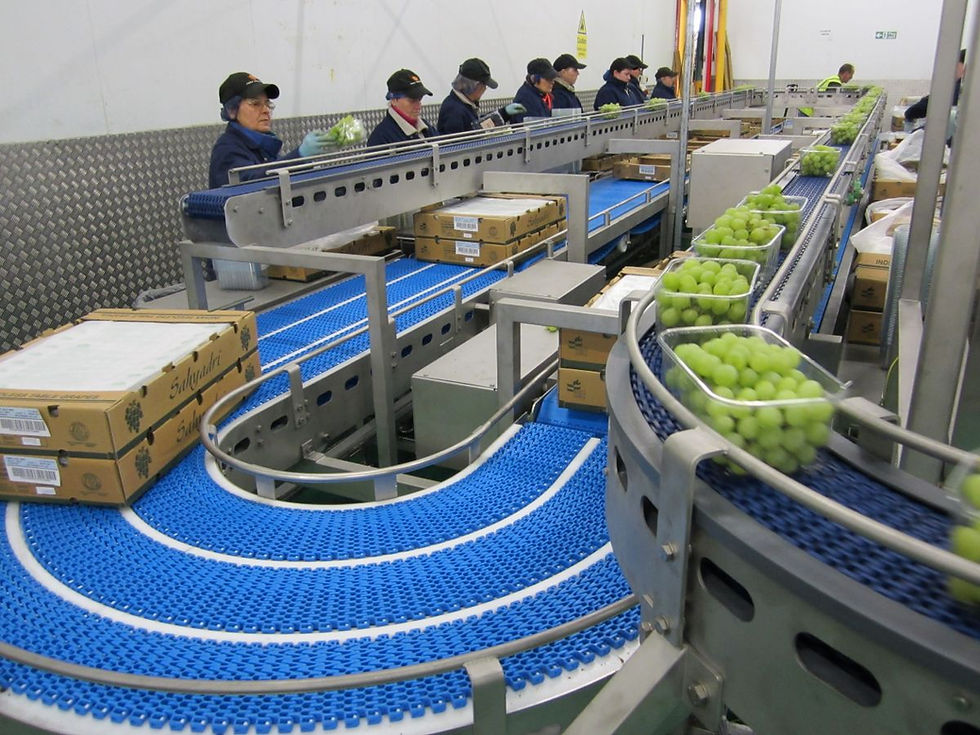
Fruit & Vegetables
Conveyor systems that can easily handle everything from leafy greens to root vegetables.
Fresh Produce & Salads
A range of options tailored to delicate, variable products and specific factory layouts.

Bakery & Snacks
Engineered to withstand demanding bakery environments, including mixing, proofing, baking, cooling, and packaging.

Ready Meals
Custom-made ready meal conveyors built to handle high-throughput food production with precision.

Seafood
No two seafood facilities are the same. Custom conveyors are built to fit your exact operation.

Pet Food
Custom pet food conveyors: Built for hygiene and efficiency in wet and dry systems.

Confectionary
Designed for gentle handling with precise control, ensuring hygiene, flow, and efficiency.
Custom Conveyor Types for Food Processing
Every conveyor is built in stainless steel and designed to meet the demands of food production environments.

Horizontal Conveyors
Ideal for straight-line product transfer across your production area.
Available in stainless steel with a range of belt options, fully tailored to integrate into new or existing lines.

Incline / Decline Conveyors
Designed to move product efficiently between different elevations. Custom-built with the right belt type and angle to ensure smooth, controlled handling.
Radius Conveyors
Perfect for navigating corners while maintaining product flow and line efficiency. Engineered to suit your layout, with a solid stainless steel construction.

Shuttle Conveyors
Used to distribute product across multiple lines or positions with precision. Fully automated and configurable to suit your process, improving flexibility and throughput.

Bi-Directional Conveyors
Allows product to travel in both directions for maximum operational flexibility. Ideal for dynamic production environments and easily integrated into existing systems.

All of the Above
We can combine multiple conveyor types to create a fully bespoke system tailored to your process.
Everything is designed to work seamlessly together!


Food Industry Conveyor Belts — Specified for Your Application
Selecting the right food industry conveyor belt is critical to hygiene, reliability and product quality. We specify and build conveyors using the most suitable belt for your product and process.
PU Belts
Smooth, hygienic belts ideal for meat, poultry, bakery and ready meals.

Roller Belts
Positive-drive belts designed for high hygiene and reduced bacteria traps.
Modular Belts
Versatile plastic belts suitable for wet environments, curves and inclines.
Wire Belt
Wire mesh belts used in sectors requiring good airflow, drainage, and easy cleaning.
Frequently Asked Questions
A custom food conveyor is designed specifically around your product, process, hygiene requirements and site constraints, rather than adapted from a standard design. This ensures better performance, cleaner operation and longer service life.
Every project is managed by an experienced Wrightfield project manager who coordinates design, manufacture, procurement, installation and commissioning—ensuring clear communication, realistic timelines and minimal disruption to your operation.
A site survey allows us to assess space constraints, existing equipment, hygiene requirements, access for installation, cleaning routines and future expansion needs. This ensures the conveyor fits your site and integrates smoothly into your process.
We follow established hygienic design principles, including smooth surfaces, minimal bacteria traps, food-safe materials, open-frame construction where required, and easy access for cleaning and inspection.
We specify proven, industry-approved components and belts from reputable manufacturers. All materials are selected for food safety, durability and performance, and each conveyor is built and tested in-house before installation.
Yes. Our food processing conveyors are used across meat, poultry, bakery, produce, salads, ready meals, seafood, dairy and frozen foods. Each system is tailored to the specific demands of the sector.
Our engineering design covers mechanical layout, hygienic design principles, belt specification, drive selection, guarding, safety compliance, cleanability, maintenance access and integration with upstream and downstream equipment.
The design process typically includes:
-
Initial consultation and site survey
-
Concept design and layout approval
-
Detailed engineering and specification
-
In-house manufacture and build
-
Installation, testing and commissioning
Each stage is reviewed with you before moving forward.
-
Yes. We regularly design conveyors to integrate seamlessly into existing food processing lines, whether replacing ageing equipment or improving flow between machines.
There is no single "best" belt. We specify the belt based on product type, hygiene level, temperature, moisture, and operating environment—commonly using PU, modular, thermodrive, wire or specialist belts where appropriate.
Yes. We design meat processing conveyors and poultry systems that meet strict hygiene, cleanability and food safety requirements, including high-care and washdown environments.
Yes. We support our conveyor systems throughout their lifecycle with spare parts, servicing, maintenance and technical support to ensure long-term reliability and performance.